Scene Deconstruction with Kit Fraser
Kit Fraser was named a “Breakthrough Brit” by BAFTA in 2017 in recognition of his outstanding work on films such as Under the Shadow (2016). Since this, Kit has continued to bring psychological depth and visual precision to his projects – most recently in Hallow Road (2025), directed by Babak Anvari.
Hallow Road is a psychological thriller that follows paramedic Maddie (Rosamund Pike) and her husband Frank (Matthew Rhys) after they receive a chilling phone call from their daughter, Alice. Following a family argument, Alice has taken Frank’s car and while driving through a dark forest, she’s hit a girl that’s run into the road. As Maddie and Frank race towards Alice’s location – Hallow Road – the full story of the night’s events starts to unfold.
Key Insights
- When transitioning between the VENICE 2 alongside a 16mm film camera, this can create distinctly different looks that influence the tone of the story when filming certain scenes.
- Constructing a prop car with easily removable sections allowed the crew to shoot a wider range of in-car shots, making it possible to perform camera moves not possible with a normal car body.
- By strategically positioning 2 cameras of a different type/setup in different sections on a beamsplitter 3D rig such that each camera sees the same thing, you can create various effects within a single shot by blending the output of one camera with the other.
Why Sony VENICE 2?
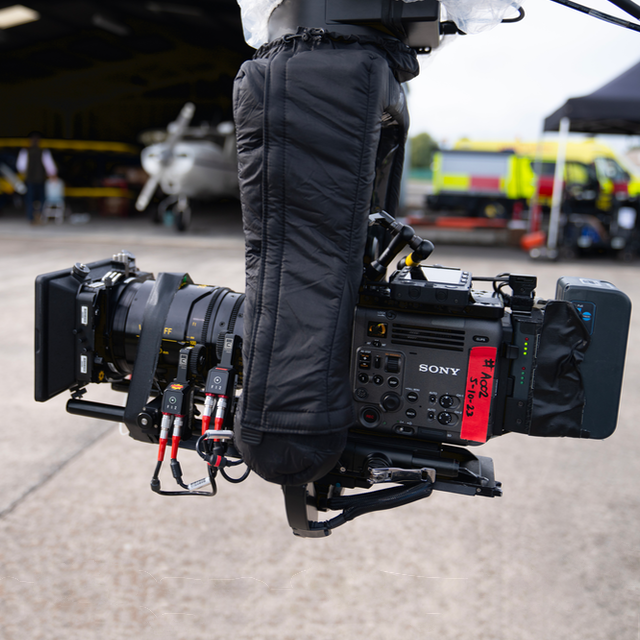
Kit chose to shoot with the VENICE 2 for several reasons, one of the main being the need to shoot within the confined space of a car. For this, he used the VENICE Extension System 2, allowing the camera’s sensor block to be separated from the main body of the camera to create a very small camera head.
The use of the VENICE Extension System 2 mode on the VENICE 2 is just brilliant for the car shots, because it just meant that we could place that front part of the camera body in so many different areas that we couldn't otherwise place a bigger camera body.
Kit Fraser

Another reason for choosing the VENICE 2 is its large colour gamut and its colour reproduction. Kit finds that as well as delivering great looking skin tones the wide colour range allowed him to introduce vivid primary colours for certain points within the film without any of the digital breakup that can sometimes occur with some other camera systems.

We wanted to do things with really vivid primary colours at certain points in the film, and you can see that break up quite a lot on digital formats sometimes. So, I think for us it became quite an easy choice to shoot with the VENICE 2.
Kit Fraser
Scene 1: Bedroom Scene
The beginning and ending scenes of the film were shot entirely on location, handheld, using 16mm film; Kit chose to use a very free and loose compositional style for these handheld shots which, combined with the film grain, gave these shots a rougher feel. In between, the majority of the film takes place inside Maddie and Frank’s car, with these sequences being shot on the VENICE 2 for a more defined look.

In the bedroom scene, Alice’s parents have just learnt that she has been in a car accident and they are scrambling to leave the house to search for her. To allow the camera to move very freely, to whip pan, and to allow the audience to see the inside of the house, Kit kept the lighting very broad and centred around easy-to-move practical light sources – these were kept away from the talent so they could move about with their faces indirectly lit. To supplement the in-shot practical lights, Astera tube lights were rigged to small sections of truss on the ceiling, whilst tented windows helped push a warm, greenish sodium vapour-style light through the windows.

We wanted the camera work to become really tight, really defined frames. Our simple formula was, it starts with a rougher edge and ends with a much tighter, fine look to it.
Kit Fraser
Scene 2: Film to Digital
To achieve a seamless transition from film to digital within a single shot, the crew used a 3D stereoscopic rig on a track mounted Scorpio camera crane. Onto this rig, they mounted the VENICE 2 and an 16mm film camera. Both cameras were shooting simultaneously, lined up so that they both saw the same image, the 16mm film shooting straight through the rig’s 50/50 mirror and the VENICE 2 shooting the reflected image – the VENICE 2’s image flip function correcting for the mirrored image.

The system was then tracked in towards the car and as the rig reached where the cars windscreen would normally be, the shot transitions from the grainy 16mm film to the clean, digital image from the VENICE 2.
We wanted the effect to be subtle, but we also wanted a kind of keen audience to look at it and think, "Hang on, something's changed there. What's happening here?" And even if it was just a kind of subconscious thought when they're watching it to signify a change in the script and the tone, which I think does happen more if it's in a seamless transition as opposed to a cut.
Kit Fraser

For lighting this scene, Kit didn’t want to have any kind of overt style; he wanted this scene to feel real with the impression of security lights lighting the driveway and streetlights beyond this.
To achieve this, he generated very large soft sources by creating a wedge light. The wedge light was created by bouncing tungsten lamps off sheets of polyboard or ultrabounce fabric on a frame, where the reflected light coming through a large diffusion frame creates an extremely soft, broad light. Then to give the sense of the security light and streetlights, he used a mix of Vortex 8 and Vortex 4 panel lights on tall stands adjusted to give a sodium vapour style.

Scene 3: Lego Car
With so much of the film taking place within the car, it was realised early on that many parts of the car – e.g. the windscreen surround or door pillars – would make it difficult to create a wide variety of shots. So, special effects co-ordinator Will Carstairs created what became known as the ‘Lego Car’.

This prop car could be taken apart and put back together quickly and easily. By undoing a few bolts, the windscreen pillars, doors, or other parts could be removed. It allowed them to perform clever and normally very complex moves such as a move up from the footwell, past the legs, arms, up to a face, and around the occupants.

It meant that we could then just continue shooting and finding those kind of crazy different angles that we couldn't have otherwise done if there was a full car body.
Kit Fraser

When filming the car shots in the virtual production studio, to maintain a realistic and natural look and to avoid the actors from looking lit, Kit wanted to surround the outside of the car with light sources.
As well as the light from the virtual production screen, they used lighting rigs on wheeled trusses that could be moved in and out as needed. There were lighting rigs above the car and for up-lighting they placed lights on the studio floor.
Colour Shift
The film starts with a warm overall look but ends with a much colder look. If you observe a freeze frame from the start of the film and compare it to one from the end, this difference is obvious. But throughout, there is no sudden jump in the colours – this colour shift was carefully planned from the very beginning.

To achieve this subtle shift, Kit broke down the script into around 40 sections. Each of these sections was assigned a colour temperature very slightly colder than the previous, starting at around 2300K and finishing around 6300K. As each section was shot, subtly adjusting the Kelvin values to set the colour temperature of the lights meant the film gradually changes from warm at the start to cool at the end.