Scene Deconstruction with Tim Sidell BSC
Go behind the scenes of the highly acclaimed second season of The Night Manager, now available to watch on Amazon Prime. Following the success of its first season, the series earned nominations at the Primetime Emmy Awards, Golden Globes, and BAFTA Awards, with wins and accolades highlighting its standout performances, direction, and production quality.
Directed by Georgi Banks-Davies and shot by Director of Photography Tim Sidell BSC using the Sony VENICE 2, season 2 follows ex-soldier turned undercover agent Jonathan Pine (Tom Hiddleston), as he searches for the truth. His investigation leads him down a trail of espionage and betrayal to Colombia, where he once again comes face-to-face with ruthless arms dealer Richard Roper (Hugh Laurie).
Key Insights:
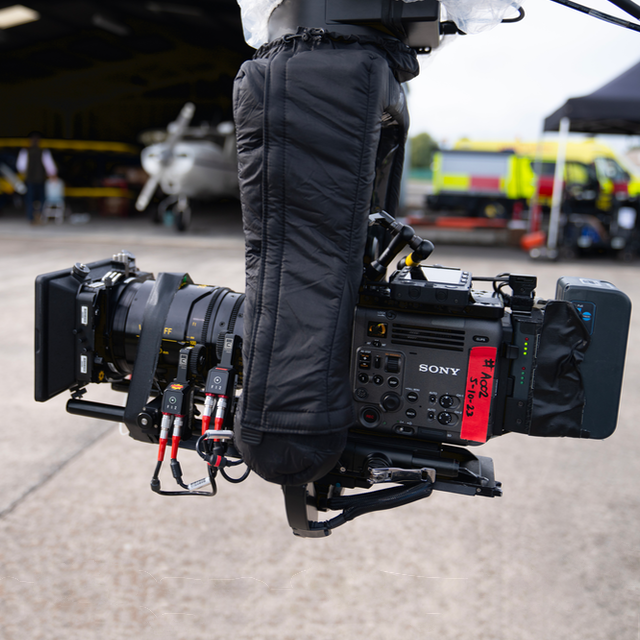
- Shots with a handheld feel, but with more elegant control, can be created by under-slinging the camera on a jib arm. With little or no damping, the camera can be operated like a handheld camera but without excessive wobble or shake.
- The Art Department make a considerable contribution to the look and feel of a scene. Colour and material choices during the set design and build will influence the way light may enter scene or be bounced around the space you are shooting in.
- Lights mounted on dollies & tracks outside a window, and then moved along the track using ropes, can be used to create moving beams of light similar to those from a car’s headlights.

Tim’s inspiration for the overall look of the series came from espionage films such as Francis Ford Coppola’s 1974 film, The Conversation. Tim used compromised camera angles and very long focal lengths to make the audience feel like they were spying on conversations.
We just loved playing with subjectivity and this influenced the way we moved the camera and the lenses we used.
Tim Sidell BSC

Subjectivity is one of Tim’s visual signatures. It is the way he uses the camera to explore a character’s identity. He loves to move the camera, to anchor it to a person to give a sense of not just watching, but sharing that character’s experience.
To create a more authentic, edgy and reactive look instead of rehearsing scenes, the scene would be blocked for lighting and to establish key camera positions, but from there the crew would go straight into an unrehearsed take.
Why did Tim choose the Sony VENICE 2?
I’ve been using it [VENICE 2] since it came out and I’ve loved it. Some digital cameras don’t have a very pleasant texture, if any at all. I find with the VENICE 2 I can achieve some texture… But primarily it’s colour, the VENICE 2 holds colour in a very organic way and this comes through in skin and you read emotion in that skin more than with other cameras.
Tim Sidell BSC
The main lenses were Leitz HUGO primes, but for the scenes where Pine used his undercover alias of banker Matthew Ellis, Tim used his own TLS rehoused Mamiya 645 Sekor C Medium Format lenses.
Scene 1: Hostage
This scene takes place in a hotel room where Roxana (Camila Morrone) has been taken hostage. To help create a sense of danger, the room is kept dark.
Tim frequently shot with 2 cameras and the schedule was tight, so to speed up the shooting process, the room was lit with 4 to 6 soft LED lights arranged in a ring around the room, just above the top of the frame. Each light was on a dimmer so that as the crew moved around the room, the levels could be adjusted to provide a wrap of backlight with soft fill from the front.


To provide colour contrast, practical lights were added. Tim placed a green-yellow tube light above the sink mirror and a warm tungsten table lamp beside the bed. Then to add a large splash of colour, neon red coloured lights were placed outside the bedroom window. These lights reflected off the walls of the room and the actors’ faces for a dark, but also interesting look and feel.
This is VENICE 2 doing its thing - the shadow detail is phenomenal, it’s rich in colour, it’s organic, some cameras are very cyan or a bit monochrome or get a bit blocky, the VENICE 2 doesn’t, it goes deep, deep, deep, just like film.
Tim Sidell BSC
Scene 2: The Documents
In this scene, Pine is breaking into an office attempting to steal some shipping documents to use as evidence against Roper. In the script, this scene describes Pine being in a dark office. Tim explains that this is a classic cinematography problem; the room can’t all be dark, we need to see something, so what can we see? To really bring this dark scene to life, as well as including some subtle greenish fluorescent light and orange looking sodium light, Tim decided to add sweeps of light across the room as if cars with bright headlights were passing outside. This light created both movement as well as moments of fluctuating brightness.

To achieve the effect, Tim’s gaffer rigged 2K and 1K light sources on dolly tracks, and the sparks used ropes to pull the lights along the tracks to create the illusion of a car passing by. They found the effect was even more convincing if instead of the lights shining directly into the room, they were bounced off multiple reflector boards placed opposite the windows so that the light would come and go several times adding a sense of rhythm. Tim was able to go much brighter with these moving lights than would have been appropriate for a static light.

Another way Tim likes to bring movement into a shot is by shooting handheld, but he also likes to use a technique that he calls “floaty jib”. This technique involves using an Atlas 7 fluid head to under-sling a camera on a jib arm. By using only minimal amounts of damping the shot still has that handheld feel, but the movement is more refined. As the camera is on a jib, it makes it easy to shoot over-the-shoulder and point-of-view style shots, as well as shots where the camera tracks up or down. Tim used the floaty jib in this scene to add soft and gentle movements that allow the audience to sit back and just observe what’s happening in the scene.
Scene 3: Returning Home
In this scene, we see Roxanna returning to her old and rundown family holiday home. The house used for the film already had a lot of interesting textures on the outside, but initially the inside had plain white walls. Tim worked with production designer Víctor Molero and his team to develop a range of colours and textures for the inside. All the lighting for the scene, including the interior shots, was done from the outside, mostly using 6K HMI’s set on the ground below the windows. These were aimed upwards and bounced off various materials back into the window of the house towards the floor.

To create a feeling of sunlight, Tim used a 6K PAR bounced off a CRLS reflector for a harder light. CRLS is a system that gives precise control over the quality of reflected light by using mirror-like reflectors with varying degrees of diffusion and softness.
Additional bounced lights were placed out of shot around the windows to provide additional ambience where needed. But the main thing Tim wanted to achieve was a sense of the only source of light in this run-down building being exterior sunlight, all the while trying to retain the freedom to be able to shoot from multiple angles.

Shooting with the only light coming from outside the rooms would be a challenge for any camera, but Tim felt that the VENICE 2 coped really well. There are many times when the actors are completely backlit and their faces are 4 stops underexposed, yet you can still clearly see their expressions and emotions.

The dual ISO is brilliant, you can push – work at a base of 800, shoot at 1600 [EI] to push it a little bit or to protect the highlights a little bit, it’s very versatile
Tim Sidell BSC
Tim also finds the VENICE 2’s ND filter system very liberating. He tells of how no matter what the light does, he can quickly select the most appropriate amount of ND, from no ND to 2.4ND, in one stop steps, instantly.
Scene 4: The Cabrera Camp
One of Roper’s henchmen, Teddy (Diego Calva) has brought Pine to a jungle camp. Pine is thrown to the floor of a small shack while members of Roper’s gang roughly interrogate him. Tim was keen to try and create a sense of entrapment and he wanted the viewer to not only see, but feel and understand what Pine was going through. To help achieve this, Tim used the VENICE Extension System to separate the camera’s sensor unit from the camera body. He could then hand hold this now much smaller and lighter camera head. It allowed him to track all the way down to ground level as Pine is pushed to the floor, maintaining that sense of being not just an observer, but a part of what is happening to him.

Tim finds that when using the VENICE Extension System, the reduced mass and weight of the camera head allows him to hold and control the camera using his core muscles, and this creates a fluidity and smoothness that can be difficult to achieve with a heavy camera on your shoulder.
Most of the light in this scene comes from outside the shack, through large sheets of yellowed and dirty plastic that make up parts of its walls. Again, this shows the importance of working closely with the art department. The rest of the light is browns and greens from the forest outside and the wooden structure. There is a moment where Pine spits out a mouth full of bright red blood, the vividness of the red blood contrasting against the more muted browns and greens in the rest of the shack.

This was the first time that Tim had worked on a production using an ACES (Academy Colour Encoding System) workflow. The VENICE 2 camera includes an ACES monitoring pipeline, and the metadata in the 16 bit X-OCN files ensures the footage is correctly handled during the ACES post production. Tim felt that ACES gave him better colour separation and, as a result, more control over the colours in the images.
Tim says that working on Season 2 of The Night Manager was a wonderful journey. It was a bigger project than any of his previous ones. As a result, he had to let go of some things and allow others to assist but in the end, that turned into a really positive experience.