Scene Deconstruction with Ben Wheeler BSC
Ben Wheeler BSC became a member of the Children’s Film Unit when he was 13. During evening, weekend and holiday workshops, this UK charity taught every aspect of film production to young people aged between 10 and 16. Each year, the unit would produce a film that would have a theatrical release, and it was here that Ben’s fascination with cinematography started. This young start led to a long career as a highly regarded Director of Photography working on many high-profile productions including The Inbetweeners, Lockwood and Co, and The Tourist.
In this Deconstruction, Ben takes us behind the scenes of The Jetty, a 4-part miniseries thriller created for the BBC by Cat Jones and directed by Marialy Rivas. The story follows detective Ember Manning as she investigates an arson in a lakeside town in Northern England. The investigation forces her to look back at her formative years and the series contains two timelines, past and present, that explore how the relationships between men and women have changed over the years.

The look of the show was inspired by the concept of fire representing men, and water representing women. To achieve this, wherever possible Ben used lots of colour contrast; where perhaps the main light was a warm sodium light, this would be contrasted with cool blue moonlight. In daylight scenes, Ben would introduce some warm tungsten light to contrast the cooler daylight.

We were very keen for a cinematic look, we went with the Sony VENICE 2, which I’d used before on The Tourist and was a huge fan of. I think it’s got brilliant colour rendition and a lovely roll off in the highlights.
Ben Wheeler BSC
Scene Deconstruction: Key Insights
By setting the colour temperature of the principal lights for nighttime scenes to 5000K and the camera to 4000K, the lights will appear slightly blue, giving the sense of the light being cool moonlight.
When Ben needed to shoot quickly, he would use 2 cameras – one shooting a wide shot while the other camera was used for the close ups. This technique was especially useful when trying to shoot scenes around sunset or early evening where the light would change very rapidly.
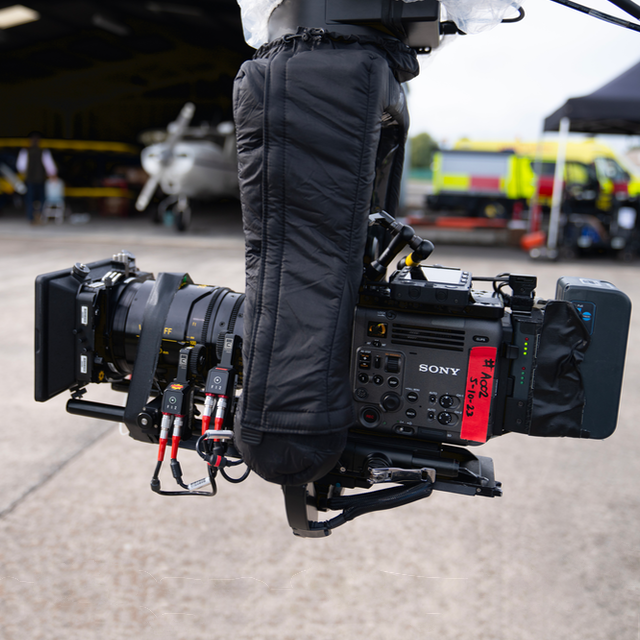
The VENICE Extension System 2 allows the cameras sensor unit to be separated from the rest of the camera body. Having a very small camera head makes shooting in cars easier which allowed Ben to create rapid camera movements in the tight confines of a car.
Scene 1: Boat House
In this nighttime scene, Ember and her colleague, Hitch, visit a boat house to see what’s going on there. But when they arrive, they find that another person is taking photos and learn that someone else is also investigating the same crime.

Ben chose to light the scene using practical lights as much as possible. This would allow the camera to move around within the scene without needing to re-light. To create an overall ambience, Ben mounted Vortex 8 panel lights set to 5000K on aerial platforms to resemble moonlight.

The camera was set to 4000K so that this light would appear slightly cool. Atlas light fixtures were added to the buildings to represent security lights and pocket-sized DMG Dash LED lights set to produce red light were mounted on the scaffolding around the building to add a colour accent.

Scene 2: Meeting Malachy
This scene takes place in the evening, where we see Caitlin meet Malachy for the first time.
For this scene, Ben used 2 cameras to speed up the shooting process as he knew that the best of the evening light would not last long. Having a second camera allowed the crew to work more quickly, with the two cameras leapfrogging each other, making the most of the best light.

Ben Wheeler: “We really embraced the flare and embraced the warm backlight. The VENICE 2 held up brilliantly, I think that holding those highlights and how it rolls off in the sun, you know, the sun is probably the only thing that’s just about clipping, right in the centre of the sun.”
Where necessary, to increase the contrast in the shots Ben used flags and negative fill to help shape the light.

We knew we were going to have to use quite a bit of available light, but we also knew we were going to be in very dark locations and locations that were hard to access so using the dual ISO was always going to be really helpful for us.
Ben Wheeler BSC

Scene 3: When You Were Young
In this twilight scene, we see the jetty is a key character within the story. We also see the connection between the two young girls and the first time they kiss. Music is used to link this scene from the past with scenes from the present, and we see the two girls dancing around a fire.

As the scene was shot at dusk, it was already very dark. The fire cast a gentle light onto the girls, but Ben used some Astera tube light set to their flicker mode to add a little extra warm light to the firelight. Ben found it a challenge to keep the correct balance between the dim dusk light and the warm light from the fire; he describes it as a juggling act, bringing down the level of the additional light from the Astera tubes as the ambient light level continued to fall.

For the earlier of the two timelines, a freer shooting style was chosen with more floaty and playful handheld shots to emphasise the youth of the two girls. This freedom of movement, and an almost documentary shooting method, helped Ben to shoot quickly for scenes with rapidly changing light levels.
So, for this scene, Ben placed several V4 fixtures on tall stands on the far side of the lake such that their warm light would reflect off the water’s surface, giving the illusion of distant street lights and prevent the water from just disappearing into nothing but blackness.
Water is a difficult thing. Almost like lighting a car, you need to reflect stuff in it, you can’t just light it, you can’t just throw light at it.
Ben Wheeler BSC

Scene 4: Flashbacks
In this car sequence, it was important that the viewer saw the action from Ember’s perspective. To achieve this a Pod Car was used, a type of car where a stunt driver drives the car from a seat and controls on its roof, allowing the actors to concentrate on their acting. Ben chose to use the VENICE Extension System 2 to separate the camera’s sensor block from the main body of the camera. This creates a very small camera that is easy to hand hold.

This very compact unit allowed Ben to move the camera freely and rapidly, to rotate the camera to look out of a side window, then spin it around to the other side window, to look at the rear-view mirror, to look ahead, to give the drivers point of view. This view had to match specific points in the script, so having this light and easy-to-use setup proved extremely beneficial.

A shift and tilt lens allows you choose a very selective focal plane, so if you were looking across a plane of focus you could put the focus on one eye rather than both eyes and you can shift that focus.
Ben Wheeler BSC

Originally, Ben had wanted to use shift and tilt lenses for the flashback sequences, but it was realised that there wouldn’t be time, and some of the shots would also need to be seen without the shift and tilt effect. Instead, Ben worked with post-production to add warp and focus effects that would mimic a shift and tilt lens, and this was used for a lot of the flashbacks to give them a slightly warped perspective.

Scene 5: Breaking In
In this scene, Ember breaks the boundaries of her work as a detective and enters a location illegally. This was a long scene, where Ben wanted the actors to be able to move freely through the space, allowing the tension to build without interruption. It’s a technique Ben likes to try to make possible, as much as possible, by avoiding floor-mounted lights or fixed marks that the actors must hit.

The scene takes place in a building with a dark interior lit predominantly by the light from small windows. The location allowed Ben to place 4K lights outside the windows, which were covered with full grid cloth to diffuse the light coming through them. To eliminate changes in the light intensity, small tents were constructed around each window to block any sunlight so that the 4K lights become the sole source of soft, slightly blue light reminiscent of a cloudy, murky day.

To contrast this, Ben used a series of warm practical lights within the space. Other than the 4Ks coming through the windows, the only other film lights used in this scene were DMG Dashes used on some shelving to add additional warmth.

It goes back to the documentary sort of feel. Ultimately, what every DP is striving for is control. By pushing lights through the windows it gave us that control, it gave us the constant light that we needed, it gave us the colour we wanted, but still it felt like it was very natural.
Ben Wheeler BSC