Scene Deconstruction with Ed Wild BSC
From The Covenant to The Ministry of Ungentlemanly Warfare, Ed Wild BSC joins forces once again with Guy Ritchie on the action film Fountain of Youth (2025).
Fountain of Youth brings to life the story of archaeologist Luke Purdue, played by John Krasinki, on an epic quest for the mythical source of eternal life. Joined by his estranged sister, played by Natalie Portman, he races to decipher ancient clues that lead them across the globe in search of the Fountain of Youth.

Ed recounts that during the film’s planning stages, they loved the idea of drawing inspiration from the Steven Spielberg films of the 1990’s, particularly the Indiana Jones films. There was a lot of discussion around trying to stay away from CGI and instead using in-camera effects as much as possible.

So, it was decided to shoot with practical effects as much as possible, with each location given a unique shooting style – for example, the scenes in Austria were filmed in a more controlled, formal way whilst the scenes in Bangkok were shot in a looser, more frenetic way.
Moving The Camera

Ed enjoys camera movement especially when it is motivated by the characters in the scene. He emphasizes that careful planning and communication, particularly with the grip department, ensures the team arrives on set with the right equipment ready to go from the outset. That preparation gives them the freedom to execute complex scenes efficiently, without compromising on time pressures like figuring how to put together a makeshift rig, and rather allowing them to focus on executing the move with precision and intention.

But at the same time, if the shot is extremely short, he feels that it’s often not appropriate to spend a lot of time on a complex rig, instead putting more effort into the longer shots that get more screen time.
You have to be realistic about what you can and can’t achieve and what’s worth investing in and what’s not.
Ed Wild BSC
Key Insights
- Speed: When shooting chases and action sequences, camera angles that look down to see the ground rushing past or shots that look across and include objects that wipe quickly through the foreground of the frame help enhance the sensation of speed.
- Bikes: Using specially equipped electric motorcycles as tracking vehicles – rather than a more traditional large vehicles with a crane – can allow the camera to get closer to the action in a car chase.
- Lighting: Carefully crafted lighting can blur the boundary between in-camera & practical effects, and post-production VFX – both working together to create a convincing and believable effect.
Scene 1: Train Station
During this scene, Luke is trying to escape the Thai Mafia, where his last chance to get away from them is to catch a train out of Bangkok’s central station. This scene was shot in a real station in Bangkok where Ed had limited control over the lighting due to the open nature of the setting. In a situation like this, Ed feels that there is only so much you can do, so it’s often about setting the exposure and adjusting the light away where necessary.

But in some parts of the station, strong backlighting meant that John would have appeared as a dark silhouette against a bright background so Ed highlights that “if you’re going to go through all that trouble to put an actor on a moped through an actual live station, you can’t not see it’s him.” As such, for some areas, they used a couple of 9K lights with textile diffusion to lift the foreground.

Ed finds that this type of situation is where the Sony VENICE 2 camera really shines.
I feel really comfortable with the VENICE 2, the built-in NDs are just great and you can move really fast.
Ed Wild BSC
One of the challenges of shooting a chase scene like this is making it look fast and out of control, while keeping the shooting environment safe and controlled. Ed explains how he uses foreground objects that move quickly past the camera, or shots angled downwards so you can see the ground rushing past to emphasise the sense of speed and motion.

For the station shots, it was clear to Ed that by tracking along the length of the platform with pillars and other foreground object wiping through the shot, and a longer focal length lens to get a tight shot of John, he could emphasise the sensation of speed.
Scene 2: Bangkok Car Chase
This very first day of filming kicked off with a hectic car chase through the middle of Bangkok, with the lead actor weaving through traffic on a moped. “Just a great way to start!” Ed chuckles.

He explains that sequences like this demand extensive planning, yet still require flexibility: dialogue and blocking can evolve on the day, so the camera team must be ready to adapt without losing momentum.
The scene opens with Luke riding the moped out of an alley towards the camera, which looks great, but for the parts of the chase where there are two cars either side of John a lot could go wrong, so a towing rig was used for the moped to make things safer.

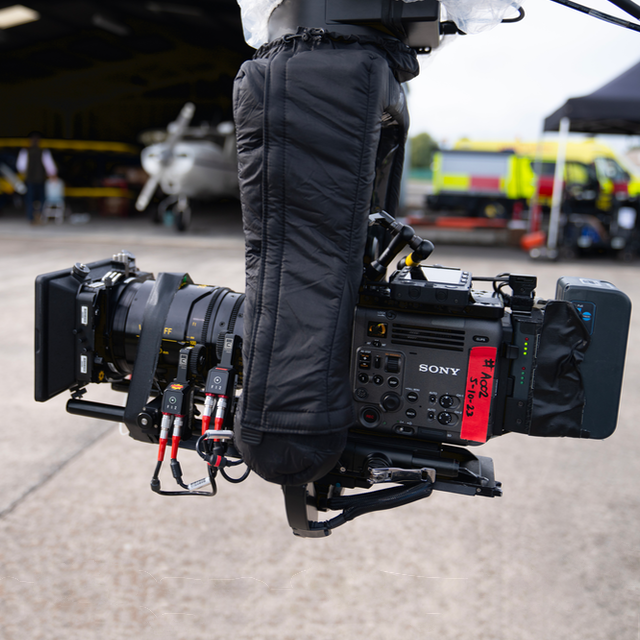
To get right into the action, Ed used electric motorbikes fitted with beams that could lift the camera up and down. These camera bikes could weave between the cars, giving more intimate and dynamic shots than would be possible with a traditional tracking car & arm setup.
Part of the chase unfolds through a bustling market. Ed tells of how when he first arrived at the market, it didn’t look like any preparation work had been done, the market appeared to be operating as normal. But he soon discovered that Barney Hughes, the floor AD had everything setup, orchestrated everything with precision; every vendor was an extra, every movement planned, and every detail designed to feel indistinguishable just like any normal market day.

Ed likes to first dress the set, then from there he looks around to visualise how best to shoot the scene, working around the location after setup in such a way that the scene doesn’t look over-constructed.

With the complex nature of the market scene, there often isn’t a chance to get a second go, so planning where to put the cameras is a very important process. As such, Ed likes to place the cameras so that they complement each other rather than capturing too many differing viewpoints.
Scene 3: Train Fight
Having fallen asleep on a Thai train, Luke wakes up to find he is facing a beautiful woman who wants the painting he has stolen.
The original plan for the scene was to shoot on a real train, but during the recce it was realised that the real train was too small to fit the cast and crew. So, a set was built to represent the inside of the train. To make it feel like an authentic Thai train, blue-green fluorescent lights were placed on the ceiling and in the background of the set, which were then dimmed down to mimic old tube lights. Small tungsten fixtures were also added to the walls to produce a warm, golden light in the setting.

Ed likes to play a lot with the camera placement when shooting dialogue; he says that you have to think a lot about any rhythm changes and then how to reflect that in the camera framing. In this scene, Luke is grabbed by the neck, then the scene transitions from dialogue to action – for Ed, that moment where John is grabbed by the neck is part of the dialogue, then the physical action that follows is still part of the dialogue. By thinking of the action as a form of dialogue it helps to create a singular, flowing scene.

When filming in the train, Ed used the Sony VENICE Extension System 2. By separating the camera sensor unit from the rest of the camera body, you end up with a smaller handheld camera that allows the camera operator to shoot from tighter spaces, such as by the train walls during these confined action scenes.
Having a VENICE Extension System 2 for that is super useful because you can be pinned up against the wall when filming.
Ed Wild BSC

Within the scene, a large knife is thrown along the carriage, embedding itself in a wall. Ed recounts of how during the planning and pre-visualisation stage for the shot, it was expected that some kind of visual effect would be used. But in the end Ed went “old school”.
We’ll just have the knife there [in the wall], we’ll whip pan to it and then just twang it. And that’s it - sometimes old-fashioned filmmaking just works really well!
Ed Wild BSC
Scene 4: Fountain of Youth

Nearing the end of the film, the cast have finally reached the Fountain of Youth which is deep inside the centre of an ancient temple. To film this scene, a large circular set which was two stories tall had been built. At the top of the set were large petals that opened to reveal a circular stairwell descending into the temple interior, down to the Fountain of Youth.

Ed wanted to create the sense of a majestic shaft of light illuminating John at the centre of the fountain. But he wanted the light to cascade gently into the shadows so that the dissipation of light was gradual and feel as though the central shaft of light was only just reaching the floor – distinct but not blowing out the ground. Rather than just using a single beam of light, an array of lights was used to create the light shaft as this gave more control. A ring of lights was also used to add very controlled amounts of light into the shadows where the rest of the cast were stood.
So fundamentally when you’re within the set, you’re actually shooting for real most of the time and then just enhancing the lighting effects.
Ed Wild BSC

Most of the colours you see in the scene were created at the time of filming, reducing the need to manipulate during post-production. Ed really wanted to blur the lines between when they would use practical lighting and in-camera effects or when they would lean on post-production, for example when implementing visual water effects.
It’s about keeping the conversation with visual effects going all the time, Pete’s just by me all the time [Pete Bebb, VFX production supervisor] and we’re just talking constantly about how do we do this, what’s the transition to this, what can I give you and what can you do with it.
Ed Wild BSC