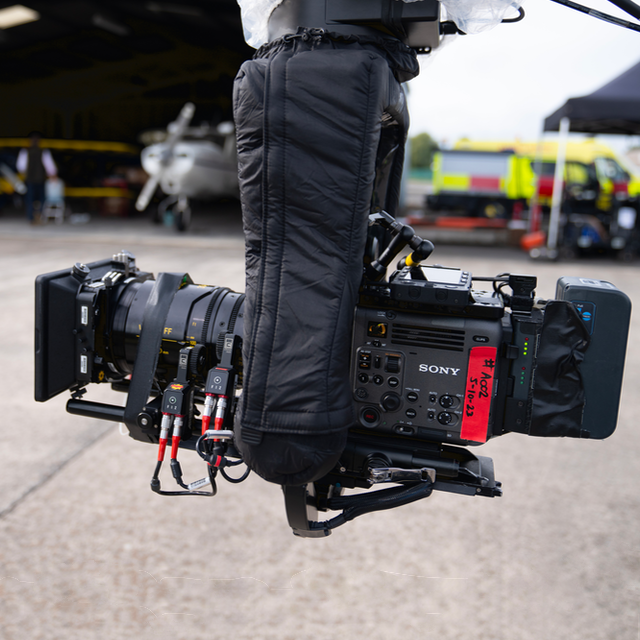
Shooting ‘Descent’ with VENICE Extension System Mini
It’s a Sunday morning in March 2025 and the concrete hallways of UAL in Stratford are eerily quiet. But passing through reception we glimpse surreally, through a series of glass doors, a woman in a pressure suit and helmet with people clustered around her. Turn another corner and the wind-up stands, lengths of dolly track and flight cases make clear that a film shoot is in progress.
This locked down film shoot is all about one of Sony’s latest and most advanced inventions – a curious little device mounted on a Ronin RS4 gimbal. Follow the cable down from it and the truth is revealed: the cable leads to a VENICE 2 camera body, and this is Sony’s new VENICE Extension System Mini.
Sony moon shot
The VENICE Extension System Mini – or Rialto Mini as people are already calling it unofficially – is an impressively tiny piece of kit. Weighing in at just 540g and smaller than a can of soda, the gadget contains the same 8.6K full-frame sensor as the original VENICE 2. The size has been reduced in part by replacing Sony’s unique ND filter wheel with individual filters that are manually slotted in and out. As with the VENICE Extension System 2, a detachable cable connects to a VENICE 2 for recording content at full quality, although this cable has been made thinner and more flexible with an even smaller detachable point allowing the cable to be threaded through tight spaces.
To demonstrate the possibilities of this new system, Sony commissioned the rising star writer-director duo the Lynch Brothers (David T. Lynch and Keith Lynch) with Kate Reid BSC as DoP. The latter is known for her work on prestige TV shows such as Silo season 2, The Baby and The Nevers (ASC nominated for best cinematography).
Their ambitious concept is to depict the future landing of the first woman on the moon. Set entirely within a 2x2x2m space capsule, the team will use the new 8K VENICE Extension System Mini to shoot within this incredibly confined space while achieving the look of a Hollywood blockbuster. With the instrument panels and other dressing, there can’t be much more than a metre’s diameter of working space inside.

The day I saw the camera, I felt really comfortable… you can operate it like a medium format stills camera and shoot from the waist.
Kate Reid BSC

Ideal for confined spaces
“It’s been amazing,” the Lynch brothers say of the VENICE Extension System Mini. “We haven’t flown out the walls once, and we had it in our heads that we were going to be flying out the walls every so often throughout, and made our poor production designer put it on wheels, and made it so we could fly out a section any time we wanted to, and we haven’t need to, because [the camera’s] just been in there the entire time.”
DP Kate Reid BSC enjoyed using the new camera system. “The day that I saw the camera at One Stop where we were prepping, I felt really comfortable,” she attests. “This camera, you can operate it like a medium format stills camera, and so shoot from the waist.”
For Descent, Kate shot with the Mini both handheld and on a small prosumer size gimbal that typically wouldn’t be able to support a standard cinema camera. Depending on the shot, Kate had the flexibility for that energetic handheld feel or a smooth, floating zero-gravity feel in an exceptionally claustrophobic set.
“I think the fact that it is a quarter of the weight makes quite a big difference, this is like 500 grams in its basic permutation,” Kate says. “If we were using it with a short prime it sat very comfortably being kind of handheld… This is so small that it feels like working almost with a compact stills camera but you’ve got the benefit of the lovely sensor and the choice of being able to put your lenses on the front of it and do all the things that you would with a traditional stills camera.”
Kate also praises the new ND system which helps make the system so compact.
“You still have the benefit of having all the same NDs that the VENICE 2 has despite it being a really small camera. It’s a different system where you take one out physically and you put the other one in but they’re all the same good quality colour match that you would have on the VENICE 2. You’ve got all the choices you know from 0.3 up to 2.4 despite it being small you’ve still got that flexibility that you’ve had with the other camera.”

We are filmmakers who love using technology to try and do something that hasn't been done before… Our first thoughts were to go for something very, very contained and you won't be able to do with a normal cinema camera.
Keith Lynch
Co-Director

Shooting at the XR Lab
The physical set sits inside the University of the Arts London Fashion, Textiles and Technology Institute XR Lab in Textiles and Dress. Funded by UK Research and Innovation, Arts and Humanities Research Council, the XR Lab was the world’s first research VP volume built using Sony’s Crystal LED VERONA panels. Walking into the room for the first time, it truly feels like the void of space.
“We’ve got a feature that’s set in space that we’re doing with Kate,” say the Lynch brothers. “We’re leaning towards doing the LED [volume for VFX] but the problem was you can’t get that deep black on them. Then we found out about these Sony VERONA ones and there’s this deep blackness of space and you can really get away with it.”
“They’re beautiful,” says Reid. “I thought the colour was great… the detail, and the fact that we weren’t that far away from them.” Her DIT John Miguel was even able to link into the screens from his Livegrade desk. “I thought that was really fascinating, that I had that level of control, to be able to add more contrast or change colour temperature [of the backgrounds] from the desk in real time and see it on the camera.”
We've got the LED volume with those Sony VERONA screens - those deep blacks which are perfect for space. It becomes this really immersive environment and you just don't realize you're in a film set… it really does have a brilliant effect - it can't be replicated.
David T. Lynch
Co-Director
Spinning in free-fall
The directors created the background content themselves, rendered out as 2D videos and stills. 3D tracking of the camera movement was not deemed necessary or practical in the confined set.
Reid remarks: “All that media… was incredibly helpful in terms of getting my head around the lighting in terms of the different states when it’s calm, and then the sun comes through and [the capsule] starts to free-fall, and then it’s spinning in all directions. So having seen what was out of the window, that was really useful to bounce in my mind when I was thinking about how we would do the lighting effects.”
A Creamsource Micro Colour is megaboomed over the top of the capsule, while two small Astera tubes set to a cool colour are rigged inside. A 2K tungsten fresnel is mounted on a dolly so it can orbit the set, while mirrors are on standby for the more chaotic sun effects required when the spacecraft goes into a spin.

Apollo anamorphics
Reid shot most of the film on Xelmus Apollo 2x anamorphics, “but I also had a set of sphericals in case they were needed for some of the shots where we had close-focus stuff, or if the shots needed to be handheld, and and having the larger anamorphic just would make it a bit cumbersome with the weight balance. But in actual fact there was only one shot of the whole shoot that was with a small Tamashii [spherical] prime.”
That shot was the film’s closing one, the camera pans up from shadow to the astronaut’s exhausted face. The capsule’s readouts reflect off her visor. She opens it and looks over at the porthole, the camera following her gaze to reveal the capsule’s shadow stretching out across the lunar surface she’s finally landed on. The camera and LED panels handle the harsh blacks and whites of the CG scene well, and the dirt on the porthole gives a verisimilitude that green-screen would struggle with.
“It’s a fun way of filming something like this where it’s just all there,” the directors remark. “I said to Anastasia, the actor, ‘All the buttons will work, the screens will be on, and the stuff out of the windows you’ll be able to see. You won’t have to imagine any of it.’”

POV with Cyclops
As if filming within the capsule wasn’t challenging enough, the team had the idea of mounting the camera on the actress’s head to give a true POV perspective of the controls and instruments as she interacted with them. It provides a truly dynamic, natural sensation of being an astronaut reacting as events unfold.
The Cyclops POV camera system is designed for exactly this scenario with a unique top down position into a split mirror. Originally created to work with the Sony FX3, the new extension system is even lighter and features the 8K VENICE 2 sensor. The VENICE Extension System Mini is a stunning technical advance for Cyclops and POV shooting – just one example of applications such as XR, stereoscopic and 360° filming that Sony expects to see transformed.
It’s amazing how you have that VENICE 2 sensor in such a small camera… it’s great that you can stay with the same sensor and codec and workflow and use the lenses that you're using on your main camera, but even in a smaller place.
Kate Reid BSC
This is an edited version of an article for issue 2 of Creators magazine, produced by British Cinematographer in collaboration with Sony, due for release in April 2025.